


To understand how to buy land in Bangladesh safely, verify the seller’s legal ownership, examine the title deed and ownership history, match CS/SA/RS/BS khatians with the dag number and mouza map, check namjari and khajna records, obtain a Non-Encumbrance Certificate (NEC) where appropriate, and confirm the required project approvals before paying. Register the sale deed through the appropriate Sub-Registrar office and complete the applicable post-registration mutation process. Never rely on a broker’s assurance or a single document as proof that land is safe to buy.
Buying land can be an important financial decision. A plot may offer long-term use or investment potential, but disputed ownership, forged documents, overlapping claims, unpaid liabilities, and unapproved development can create serious problems.
The safest approach is to follow a documented verification process before committing your money.
Key takeaways
- Verify the seller’s identity and legal authority to transfer the property.
- Check the complete title chain, relevant khatians, dag number, mouza map, and boundaries.
- Verify mutation (namjari), land development tax (khajna), and relevant government records.
- Investigate mortgages, registered interests, court disputes, acquisition notices, and other restrictions.
- Confirm the applicable development authority’s approval for land in a housing or township project.
- Use an independent property lawyer and a qualified Amin or surveyor where appropriate.
- Register the transaction properly and complete post-registration records and mutation.
- Keep certified documents, official receipts, payment evidence, and the registered deed safely.
This guide explains the process, the documents you should request, and the questions to ask before buying land in Bangladesh in 2026.
What Documents Are Needed to Buy Land in Bangladesh?
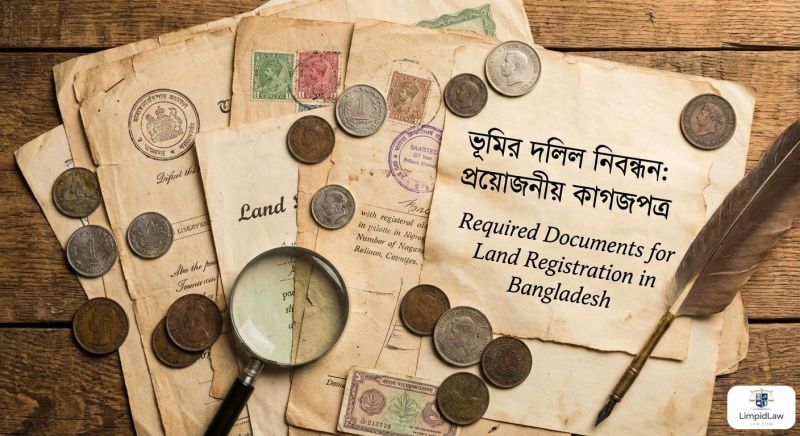
The documents required depend on the property’s ownership history, location, type, and transaction structure. The following checklist covers the main records a buyer should investigate before purchasing land.
| Document or record | What it helps verify | Who or what to consult |
|---|---|---|
| Seller’s NID or identity documents | Seller’s identity and consistency with property records | Seller and relevant official records |
| Current title deed | The seller’s claimed ownership and the property described in the deed | Sub-Registrar records and independent lawyer |
| Previous deeds | The chain of ownership and earlier transfers | Relevant Sub-Registrar offices |
| CS, SA, RS and BS khatians, where applicable | Survey and recorded land information | Official land records |
| Dag number and mouza map | The parcel’s recorded identity and location | Land office and qualified surveyor |
| Namjari or mutation khatian | Whether the land records have been updated following a transfer | AC Land office and official e-Mutation services |
| DCR | Official evidence of payment for a relevant land-record service, such as mutation | Relevant land office and official receipts |
| Khajna receipt | Land development tax payment records | Land tax records and official portal |
| NEC or relevant encumbrance search | Registered mortgages, charges, or other recorded interests within the scope of the search | Relevant Sub-Registrar office and lawyer |
| Inheritance and succession documents, where relevant | The seller’s entitlement to inherited property | Relevant records and independent lawyer |
| Power of attorney, where applicable | The representative’s legal authority to act | Registered instrument and legal review |
| Project approval and approved layout, where applicable | Whether the development has the required approval and the plot is covered | Relevant development authority |
| Sale agreement and payment receipts | Agreed terms, payment evidence, and contractual obligations | Parties, lawyer, and registration records |
Not every transaction requires every document in the same form. Ask a property lawyer to identify the records applicable to the particular land parcel.
The official Ministry of Land e-Mutation guidance explains the relationship between mutation services and land records such as khatians and mouza maps. For construction or land-use matters within its jurisdiction, RAJUK’s official permitting information also identifies documents such as deeds, khatians, mutation records, and up-to-date land development tax records.
Step 1: Verify the Seller’s Identity and Ownership
The first question is not whether the land looks attractive. It is whether the person selling it has the legal right to sell it.
Match the Seller’s Identity With the Documents
Ask the seller for appropriate identity documents and compare the name and other identifying details against the title deed, relevant land records, and supporting documents.
Pay attention to:
- Differences in names or spellings.
- Differences in the recorded owner’s details.
- Missing links in the ownership history.
- Unexplained changes in the property description.
- A seller acting through a representative.
- Multiple owners or heirs who may have rights in the property.
A mismatch does not automatically mean fraud. However, it must be explained and supported by appropriate documentation before the transaction proceeds.
If the Land Is Inherited
Inherited land requires additional care.
Establish who inherited the property, whether the seller has authority to transfer the proposed share, and whether other heirs or co-owners have rights that affect the transaction.
Request the relevant succession, inheritance, partition, and ownership documents, as applicable.
Do not assume that one family member can sell an entire property simply because that person holds some of the land documents.
If Someone Is Selling Through a Power of Attorney
A power of attorney should be checked for its validity, scope, registration where required, and whether it remains effective for the proposed transaction.
Confirm that it authorizes the specific sale and that the person executing the transaction is acting within that authority.
Have an independent lawyer review the instrument rather than accepting a photocopy or verbal explanation.
Step 2: Check the Title Deed and Ownership History
The title deed is one of the most important documents in a land purchase, but reviewing only the latest deed is not enough.
A buyer should investigate how ownership passed from earlier owners to the current seller.
Review the Chain of Title
The chain of title is the sequence of relevant documents showing how ownership or rights in the land were transferred over time.
Ask your lawyer to examine the relevant deeds and compare:
- The names of previous and current owners.
- The date and nature of each transfer.
- The land’s area and boundaries.
- Dag numbers and mouza details.
- The portions transferred in earlier transactions.
- Whether the current seller acquired the exact land being offered.
- Whether any transfer or ownership claim remains unexplained.
A break in the chain of title should be resolved before you pay a substantial amount.
Verify the Deed With Official Records
Do not depend entirely on documents supplied by the seller.
Ask your lawyer to obtain or inspect relevant records from the appropriate Sub-Registrar office. The investigation should establish whether the deed and earlier transfers correspond with the property’s recorded history.
Registration is important, but it should not be treated as an automatic guarantee that every ownership dispute or competing claim has been resolved.
The Registration Act, 1908, published in the official Bangladesh Laws database sets out registration requirements for relevant instruments affecting immovable property.
Check the Exact Land Area
A seller may advertise a particular number of decimals, but the recorded area and the land physically available must be checked.
Ask your lawyer and surveyor to compare the area described in the deed, the relevant khatians, the mouza map, and the actual parcel.
If the documents show different areas, identify the reason before proceeding.
Step 3: Understand CS, SA, RS and BS Khatians
A khatian is a land record containing information about recorded land interests and associated parcel details. Buyers commonly encounter CS, SA, RS, and BS records when checking land in Bangladesh.
The applicable records depend on the location and survey history of the property.
What Do the Different Khatians Mean?
| Record | General meaning | What to check |
|---|---|---|
| CS khatian | Cadastral Survey record | Earlier recorded ownership and parcel information |
| SA khatian | State Acquisition survey record | Relevant recorded interests following the SA survey |
| RS khatian | Revisional Survey record | Updated survey information where available |
| BS khatian | Bangladesh Survey record, where applicable | Later survey records and parcel details |
The sequence and availability of these records vary by location. Not every property will have every type of khatian.
Why Should Buyers Compare the Records?
Compare the relevant khatians with the title deed, dag number, mouza map, and other ownership records.
Look for discrepancies involving:
- Recorded owner names.
- Plot or dag numbers.
- Land area.
- Mouza identity.
- Boundaries and adjoining parcels.
- Inheritance or transfer history.
- Recorded interests that require further investigation.
A khatian is important evidence, but it should not be treated as conclusive proof of an unchallengeable title on its own.
If the records conflict, ask an independent lawyer to investigate the cause and advise which official records or corrective procedures are required.
Step 4: Verify the Dag Number, Mouza and Physical Boundaries
Land may appear correctly described in a deed while the actual parcel remains uncertain. This is why buyers should connect the legal documents to the physical land.
Match the Dag Number With the Mouza Map
A dag number identifies a parcel within the relevant land-survey records. A mouza map shows recorded parcel information within a mouza.
Ask the seller to identify the exact parcel on the appropriate map.
Then compare it with the deed, khatian, and other relevant records.
Hire a Qualified Amin or Surveyor
An Amin or qualified survey professional can help identify the parcel and assess its boundaries against the available records.
Depending on the property, the survey may help establish:
- The approximate or measured area.
- Boundary locations.
- Access roads.
- Adjoining plots.
- Potential overlaps with neighboring land.
- Differences between the recorded parcel and the land shown by the seller.
Use a suitably qualified professional and ask for a written survey report where appropriate.
A physical survey supports due diligence, but it does not replace legal title verification.
Inspect the Site Yourself
Visit the land before purchasing it.
Check the access route, neighboring properties, drainage, waterlogging, surrounding development, and visible boundary markers.
Ask neighbors about access disputes or boundary disagreements, but independently verify any information that could affect the transaction.
For land intended for residential construction, also investigate the relevant land-use requirements and whether the intended development is permitted.
Step 5: Check Namjari, DCR and Khajna Records
Mutation and land-tax records are important parts of the verification process.
They help establish whether the relevant land administration records and payments are consistent with the seller’s claims.
What Is Namjari?
Namjari, commonly called mutation, is the process of updating relevant land records following an event such as a transfer or inheritance.
Ask for the applicable mutation order and updated khatian.
You can consult the government’s e-Mutation portal for relevant services and guidance.
However, mutation does not by itself cure a defective title or resolve every competing ownership claim. It must be assessed alongside the deeds and other records.
What Is DCR?
DCR commonly refers to a Duplicate Carbon Receipt associated with certain government payments or land-record services.
For a mutation-related transaction, ask for the relevant official payment receipt and verify that it corresponds to the application or order in question.
Do not assume that possession of a DCR proves ownership of the land.
What Is Khajna?
Khajna refers to land development tax. Buyers should check the applicable tax records and recent payment receipts.
Where available, verify the information through the official system rather than relying only on a paper receipt.
The government’s Land Service Gateway provides access to digital land services. Use the appropriate official service for the relevant record and payment.
An unpaid tax entry should be investigated to establish the amount due, the responsible party, and whether it affects the transaction.
Step 6: Obtain an NEC or Conduct the Appropriate Encumbrance Search
An NEC, or Non-Encumbrance Certificate, is commonly requested as part of property due diligence. Buyers should clarify exactly what certificate or official search is available for the property and what records it covers.
What Should the Search Investigate?
Ask your lawyer to investigate relevant registered interests and potential restrictions, including:
- Registered mortgages or charges.
- Earlier transfers affecting the land.
- Registered agreements or interests relevant to the proposed purchase.
- Court orders or disputes that may affect the property.
- Acquisition or requisition notices, where relevant.
- Other restrictions identified during the title investigation.
The appropriate search depends on the property and the records maintained by the relevant offices.
Does an NEC Guarantee Clear Ownership?
No. An encumbrance search can be valuable, but its scope and limitations matter.
It may not identify every possible claim, unregistered arrangement, forged document, boundary dispute, or problem with the seller’s underlying title.
Ask the lawyer to explain what was searched, which records were examined, and whether any additional enquiries are necessary.
Step 7: Verify Housing Project and Development Approvals
Buying a plot from a private developer involves checking both the land and the development project.
A company’s reputation does not establish that every project or plot it markets has the required approvals.
Check the Relevant Development Authority
For property within RAJUK’s jurisdiction, examine the applicable project approvals, approved layout, and land-use requirements through RAJUK’s official website and its Electronic Construction Permitting System.
Outside RAJUK’s jurisdiction, identify the authority responsible for the location.
Ask for Project-Specific Documents
Request the documents applicable to the specific project and phase, including:
- Developer registration, where required.
- Approved layout plan.
- Project approval documents.
- Evidence that the advertised plot falls within the approved layout.
- Relevant land ownership and development agreements.
- Applicable land-use clearances or other permissions.
- Written infrastructure and handover commitments.
Do not assume that an approval application, preliminary plan, or approval for another phase establishes approval for the plot you intend to purchase.
Check What Has Actually Been Developed
Visit the project site and distinguish completed infrastructure from future promises.
Ask about road access, drainage, utility availability, land development, and other facilities included in the agreement.
If the developer promises future facilities, request the written terms and expected completion schedule.
Step 8: Review the Sale Agreement and Register the Transaction
Once the preliminary checks are satisfactory, your lawyer should review the proposed sale agreement and registration process.
What Should the Agreement Include?
The agreement should accurately identify the parties and the property and clearly explain the financial and legal obligations.
Check that it addresses:
- The correct plot, dag, mouza and area.
- The agreed purchase price.
- The payment schedule.
- The parties’ responsibilities.
- Relevant approval and title requirements.
- Possession and handover conditions.
- Refund and cancellation terms, where applicable.
- The consequences of breach or delay.
- The documents to be delivered.
- The intended registration process.
Do not leave important promises solely in sales conversations or informal messages.
Understand the Registration Act, 1908
The Registration Act, 1908 contains provisions governing the registration of instruments relating to immovable property.
Section 17A addresses contracts for sale of immovable property. The official law reflects a 2026 amendment changing the period for presenting such a contract for registration to 60 days from execution.
See the official text of Section 17A.
Because registration requirements depend on the type of instrument and current law, have a lawyer confirm the appropriate process for your transaction.
Register Through the Appropriate Sub-Registrar Office
Section 28 of the Registration Act generally addresses the office in whose sub-district the relevant property is situated for registration of specified instruments affecting immovable property.
You can review the official text of Section 28.
Your lawyer should confirm the correct office, documents, fees, execution requirements, and registration process before the parties proceed.
Keep Proof of Every Payment
Use traceable payment methods where possible and obtain proper receipts.
Confirm that the recipient is authorized to receive the money and that the payment matches the written agreement.
Avoid making substantial payments to an intermediary or an unrelated account without independently verifying the arrangement.
Step 9: Complete Post-Registration Mutation and Record Updates
Registration is a major transaction milestone, but buyers should also complete the applicable post-registration formalities.
Apply for Mutation Where Required
After registration, follow the relevant process to update the land records in the new owner’s name.
Submit the required documents through the official land administration process and retain the application number, orders, and receipts.
Consult the Ministry of Land e-Mutation guidance to understand the relevant process.
Update Land Tax Records
Check that the relevant land development tax records reflect the correct ownership and parcel information when required.
Keep the official receipts and records together with the registered deed and mutation documents.
Preserve the Complete Property File
Keep secure copies of the registered deed, previous deeds, relevant khatians, maps, mutation records, tax receipts, approved plans, survey reports, payment records, and legal advice.
Store the original documents safely and keep separate digital copies.
How To Buy Land Checklist: Documents to Verify Before Buying Land
Use this checklist during your site visit and legal review. Not every item applies to every property, so ask your lawyer to identify the relevant requirements.
Seller and ownership
- Seller’s identity verified.
- Seller’s legal authority to sell confirmed.
- Current title deed examined.
- Previous deeds and ownership chain reviewed.
- Inheritance, co-owner consent, or power of attorney documents checked where applicable.
Land records and boundaries
- Relevant CS/SA/RS/BS khatians collected.
- Dag number and mouza verified.
- Mouza map checked.
- Land area and boundaries compared.
- Physical survey completed where appropriate.
- Access route and neighboring boundaries inspected.
Mutation, taxes and encumbrances
- Namjari or mutation records reviewed.
- Relevant DCR and payment receipts checked.
- Khajna or land development tax records checked.
- Relevant encumbrance searches completed.
- Potential mortgages, disputes and acquisition issues investigated.
Project and transaction
- Applicable project approvals verified.
- Approved layout and exact plot checked.
- Sale agreement reviewed by a lawyer.
- Total price and payment schedule confirmed.
- Registration process and costs confirmed.
- Payment receipts secured.
- Post-registration mutation and record updates planned.
Final decision
- Independent legal review completed.
- Unresolved discrepancies addressed.
- All important promises recorded in writing.
If a critical item remains unresolved, pause the purchase until the issue has been investigated.
Questions to Ask a Land Developer Before Buying a Plot
When buying from a developer, ask these questions before booking.
Questions About Legal Ownership
- Which legal entity owns the land or has the authority to sell it?
- Can I review the relevant title deeds and ownership history?
- Which khatians, mutation records, and tax documents are available?
- Has an independent lawyer reviewed the title?
- Are there any known disputes, mortgages, acquisition issues, or restrictions?
Questions About Project Approval
- Which authority approved the project?
- Can I see the approval documents and approved layout?
- Does the approval cover the exact phase and plot being offered?
- Which roads, drainage systems, utilities, and facilities are complete?
- Which facilities remain planned, and what are the written delivery commitments?
Questions About Price and Handover
- What is the full cost, including additional charges?
- What is the payment schedule?
- What are the cancellation and refund conditions?
- When will possession and registration take place?
- What documents will I receive after the transaction?
- What remedies are available if contractual commitments are not met?
Ask for written answers and compare them with the documents rather than relying on verbal assurances.
Is Buying Land a Good Investment in Bangladesh?
Buying land can be suitable for long-term use or investment, but the outcome depends on legal ownership, purchase price, location, demand, infrastructure, holding costs, and the investor’s financial circumstances.
A low-priced plot is not necessarily a good investment. It may have weak access, unclear ownership, limited demand, or development restrictions.
Before buying land for investment, consider:
- Whether the location has credible demand.
- Whether the title and required approvals can be verified.
- Whether you can afford to hold the land without needing an immediate sale.
- Whether the total acquisition cost is reasonable compared with comparable properties.
- Whether the proposed development is realistic and properly documented.
- Whether the investment would leave you too financially concentrated in a single asset.
For a broader comparison of property and other asset classes, read MDPL’s Real Estate vs Stock Market guide. If you are weighing land against an apartment, see Plot vs Apartment: Which Investment Generates Higher Long-Term Wealth in Greater Dhaka?.
These comparisons can help frame your decision, but they cannot replace a property-specific legal and financial assessment.
Common Mistakes to Avoid When Buying Land
Relying Only on a Khatian
A khatian is important, but it does not replace the title deed, ownership history, and other relevant checks.
Assuming Mutation Proves Ownership
Mutation updates relevant land records. It does not automatically cure a defective title or resolve every competing claim.
Ignoring the Physical Survey
A deed can describe land that does not match the boundaries shown by the seller. Check the parcel on the ground with appropriate professional assistance.
Trusting a Developer’s Brand Without Checking the Project
Verify the exact legal entity, ownership documents, approval status, and plot allocation.
Paying Before Legal Verification
Do not let urgency or a discount pressure you into paying before the essential checks are complete.
Ignoring Additional Costs
Registration, taxes, professional fees, land development, and other expenses can increase the total amount you need.
Accepting Future Infrastructure Promises Without Written Terms
Ask which facilities are complete, which are approved, and which remain proposed. Confirm the developer’s contractual obligations.
Frequently Asked Questions
What documents are needed to buy land in Bangladesh?
The principal documents to investigate include the title deed, relevant previous deeds, applicable CS/SA/RS/BS khatians, dag and mouza details, mutation records, land development tax receipts, and relevant encumbrance searches. Depending on the transaction, you may also need inheritance documents, a power of attorney, project approvals, and an approved layout plan. Have an independent lawyer confirm the requirements for the specific property.
How can I verify land before buying?
Verify the seller’s identity and authority to sell, examine the title chain, compare the relevant khatians with the deed and mouza map, check mutation and tax records, investigate registered interests and disputes, and inspect the actual land. If the property is part of a housing project, confirm the applicable approvals and the exact plot’s inclusion in the approved layout.
What is the difference between a title deed and a khatian?
A title deed records a legal instrument relating to a property transaction or interest. A khatian is a land record containing information about recorded land interests and parcel details. Both can be important, but neither should be examined in isolation when verifying ownership.
Is namjari mandatory when buying land?
The applicable mutation process should be followed to update the relevant land records after a transfer. The precise requirements depend on the transaction and current land administration procedures. Confirm the necessary steps with the relevant land office and your lawyer.
What is DCR in land registration?
DCR commonly refers to a Duplicate Carbon Receipt associated with certain official payments or land-record services. A relevant DCR can help evidence a payment, but it is not itself proof of legal ownership.
What is khajna?
Khajna is the land development tax. Buyers should check the applicable tax records and official receipts and investigate any outstanding liability before completing a transaction.
What is an NEC in land purchase?
An NEC commonly refers to a Non-Encumbrance Certificate. Buyers should confirm what certificate or search is available from the relevant office and what records it covers. An encumbrance search is one part of due diligence and does not guarantee that every legal or ownership risk has been eliminated.
Should I hire a lawyer before buying land?
Yes. An independent property lawyer can review the ownership history, deeds, relevant land records, encumbrances, approvals, agreement, and registration process. A qualified surveyor or Amin can also help verify the physical parcel and boundaries.
Can I buy land from a private housing developer without checking RAJUK approval?
You should not assume that a private developer’s project is approved. Determine which development authority has jurisdiction, request the relevant approval documents, and verify that the exact project and plot are covered. Requirements differ by location, and RAJUK is not the authority for every part of Bangladesh.
Final Thoughts: Verify Before You Buy
Buying land safely in Bangladesh requires more than finding an attractive plot at a reasonable price. It requires a consistent review of the seller’s authority, title deed, ownership history, khatians, dag and mouza details, mutation, tax records, relevant encumbrances, project approvals, and physical boundaries.
The most important rule is simple: do not pay for land until the essential ownership and legal checks have been completed and any serious discrepancy has been resolved.
Use the checklist in this guide, work with an independent property lawyer, and obtain professional surveying assistance where needed.
Explore MDPL’s Property Options
If you are researching a land purchase, you can explore MDPL’s available properties and review the relevant project information before deciding whether an option fits your needs.
Contact MDPL through its official contact page to request a document checklist, ask project-specific questions, or arrange a consultation with the sales team.
Treat any developer-provided information as a starting point. Verify the property documents and relevant approvals independently before making a financial commitment.