


Let us call him Rahim. He is not a real person, but you may know someone very much like him. Rahim spent eleven years abroad, sending money home every month, and when he finally came back he had one clear plan. Buy land. Put every taka he had saved into a single plot, because his uncle once told him that land never loses.
For two years, the plot sat there. No income, no easy buyer, and a boundary dispute with a neighbour that dragged on far longer than anyone expected. Rahim was not careless. He simply had all his eggs in one basket, and the basket turned out to be heavier than he thought.
That is the quiet danger of concentrating your money. It works beautifully until the one thing you depend on does not behave. This guide is about the alternative. Risk diversification in real estate means spreading your capital across different asset types, locations and timelines, so that one slow month or one difficult document does not decide your whole financial future.
We will walk through the main asset types, show sample ways to split your capital, and explain how projects such as Matribhumi City and the Matribhumi Resort can sit inside a wider plan. Nothing here is a promise of profit. It is a way of thinking that lets you sleep better.
What Risk Diversification in Real Estate Actually Means
Diversification is a simple idea with a long track record. The US Securities and Exchange Commission describes it as investing in a variety of assets to lower the overall risk of a portfolio, or more simply, not putting all your eggs in one basket. You can read the plain language explanation on Investor.gov.
In real estate, the idea has a few layers. You can diversify by asset type, such as land, apartments, commercial space or hospitality. You can diversify by location, by spreading money across different corridors instead of one street. And you can diversify by time, by entering the market in stages instead of all at once.
Notice what diversification does not do. It does not guarantee a gain, and it does not remove risk completely. What it does is reduce the chance that one bad event damages everything you own. Think of it as a seatbelt, not an engine.
Many first time investors confuse owning several plots in the same project with being diversified. It is not quite the same thing. If the project faces a delay, every plot faces it together. Real diversification means your assets react differently to the same news.
Why Real Estate Investors in Bangladesh Need a Wider Plan Now
The real estate map around Dhaka has changed fast. According to a report by The Business Standard, about 200 housing projects have come up along the Dhaka-Mawa-Bhanga Expressway, and around 200 builders have invested close to Tk 2 lakh crore, as cited from the Real Estate and Housing Association of Bangladesh.
That is good news for the corridor, because it shows serious interest and real development. It is also a reminder that choice has exploded. When there are hundreds of projects competing for your attention, picking one and going all in becomes a bigger gamble than it looks.
The same report notes that local authorities are watching closely so that no buyer is cheated. That tells you something useful. Where demand is high, quality varies, and due diligence matters more than the brochure. A diversified approach gives you room to be careful instead of hurried.
There is also the plain matter of life. Money you put into land today may be needed for a hospital bill, a wedding or a child’s education next year. If everything is locked in one illiquid asset, you may be forced to sell at the wrong time. Diversification protects you from your own future emergencies as much as from the market.
The Main Risks Hiding Inside a Single Property Bet
Before deciding how to split your capital, it helps to name what you are protecting against. Most concentrated real estate losses come from a handful of familiar problems.
| Risk | What it looks like in real life | How diversification helps |
|---|---|---|
| Liquidity risk | You need cash quickly but cannot find a buyer at a fair price. | A cash reserve and a few easier to sell assets give you options. |
| Legal and title risk | A dispute over ownership, mutation or khatian records delays everything. | Money spread across separately verified assets limits the damage. |
| Location risk | The area you chose develops slower than expected. | Holding assets in more than one corridor balances slow and fast zones. |
| Income risk | Land earns nothing while you wait, and holding costs continue. | Adding rental or operating assets brings some cash flow. |
| Timing risk | You buy everything at a market peak. | Entering in stages averages your entry price. |
Look at that table for a moment and ask which row worries you most. Your answer says a lot about how your own mix should look. A retired person may fear liquidity risk. A young professional with a stable salary may care more about timing.
The Asset Types You Can Mix in a Real Estate Portfolio
Each asset type has its own personality. Some are patient and quiet. Others pay you along the way but ask more of your time. A healthy mix usually blends a few of them.
Residential land and plots
Land is the classic starting point in Bangladesh, and for good reason. It has no maintenance bills, no tenants and no wear and tear. Value tends to follow infrastructure, road access and nearby development over the long run.
The trade off is that land usually pays nothing until you sell, and selling can take time. A planned township helps here, because roads, drainage and civic spaces are designed in from the start. At Matribhumi City, for example, the project layout lists 3,707 plots across roughly 750 bighas, with plot sizes from 3 katha up to 20 katha. You can study the project layout and the project location before you decide anything.
Rental apartments and commercial space
Apartments and shops bring monthly rent, which is the thing land cannot offer. They also need management, repairs and the occasional difficult tenant. Vacancy is a real cost, and it tends to show up when you least expect it.
Commercial space near growing settlements can be attractive, but it depends heavily on footfall. A shop in a half empty area earns very little. So treat rental property as an income engine that needs regular attention, not a set and forget asset.
Resort and hospitality ownership shares
Some developers now offer ownership shares in resorts, where buyers hold a stake in a hospitality project. Matribhumi Resort, planned beside the Nimtala bus stand on the Dhaka-Mawa Highway, is one example listed on the Matribhumi Developer and Properties Ltd. website.
This category can add variety, because tourism income behaves differently from land prices. But it also has the most moving parts. Returns depend on construction finishing, the resort opening, occupancy and how the business is run. Read the share agreement slowly, and be cautious with any wording that sounds like a guaranteed payout.
REITs and real estate fund units
A Real Estate Investment Trust pools money from many investors to hold property, and units can usually be traded like shares. Bangladesh took a formal step here when the securities regulator finalised its REIT rules. According to The Business Standard, a REIT fund needs a minimum size of Tk 200 crore, with sponsors contributing at least 20 percent.
A KPMG regulatory note explains that such funds can follow a development scheme or a rental scheme. For a small investor, units in a regulated fund offer easier entry and exit than buying a whole property. Check the Bangladesh Securities and Exchange Commission for what is actually available at the time you invest.
A cash reserve
This one is not glamorous, and it is the piece people skip most. Keep a portion in savings or short term deposits. It is what stops you from selling land in a hurry when life throws a surprise.
Here is how the five compare side by side.
| Asset type | Liquidity | Regular income | Effort required | Main thing to watch |
|---|---|---|---|---|
| Land and plots | Low to medium | None | Low | Title records and access roads |
| Rental property | Medium | Yes | High | Vacancy and upkeep costs |
| Resort shares | Low | Depends on operations | Low | Construction and operating progress |
| REIT or fund units | Higher | Possible dividends | Low | Fund rules and valuation |
| Cash reserve | Highest | Small interest | Very low | Inflation over time |
How to Split Your Capital: Three Sample Approaches
There is no single right split. Your age, income, family duties and comfort with waiting all matter. The three examples below are only illustrations to help you think, and they are not personal financial advice.
| Investor profile | Land and plots | Rental property | Resort shares | REIT or fund units | Cash reserve |
|---|---|---|---|---|---|
| Conservative | 25% | 30% | 5% | 10% | 30% |
| Balanced | 35% | 25% | 10% | 10% | 20% |
| Growth focused | 40% | 20% | 15% | 15% | 10% |
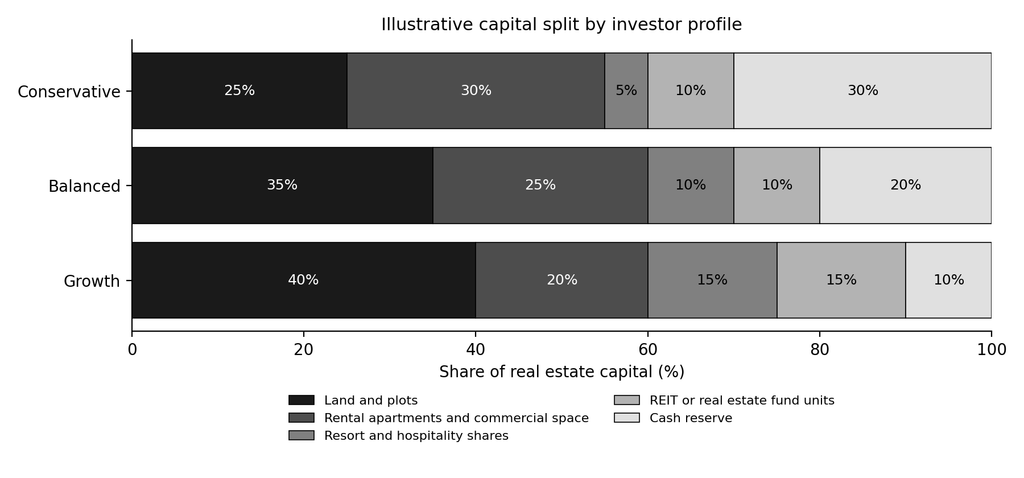
The conservative mix keeps a large cash cushion and leans on rental income. It suits someone who values sleep over speed. The growth mix accepts longer waiting periods in exchange for more exposure to land and project based assets, so it suits someone with a steady salary and few urgent needs.
Most people land somewhere in the balanced middle, and that is fine. The point of the table is not the exact numbers. It is the habit of deciding on a split before you fall in love with any single deal.
Diversifying Inside One Asset Class: Location, Size and Timing
You can also diversify within land itself. This is where many careful buyers quietly do their best work.
- Split by size. Instead of one large plot, consider two or three smaller ones. Smaller plots are often easier to resell, and a 3 or 5 katha plot draws a wider pool of buyers than a large one.
- Split by location. Do not stack everything in one block or one corridor. A mix of a growing expressway area and an established suburb balances speed against stability.
- Split by time. Buy in two or three rounds over a year or two, if your budget allows. You avoid the regret of committing everything at a single price point.
- Split by purpose. Keep one plot for possible self use, such as building a home later, and treat another purely as a long term holding.
This kind of layering costs a bit more in paperwork. Still, it gives you flexibility that a single large purchase never can. If you are comparing options in a specific project, the current price list and the project brochure help you plan realistic combinations.
Where Matribhumi Fits Inside a Diversified Plan
Matribhumi Developer and Properties Ltd. presents itself through three featured projects: Matribhumi City, Matribhumi Resort and Matribhumi Hospital. Each one plays a different role, which makes them useful examples for a diversification conversation.
According to the company’s own project details, Matribhumi City sits about 18 km from Dhaka Zero Point, adjacent to Nimtola on the Dhaka-Mawa Expressway. It is planned with wide roads, a lake, parks, schools and other civic spaces. For a buyer, that makes it a land and community holding, the slower and steadier part of a portfolio.
The resort is a different kind of exposure. It is tied to tourism and hospitality, so its results depend on how the project is built and operated, not only on land values. A buyer who wants some variety beyond plots may look at it as one slice of a larger mix, sized carefully.
Here is the honest framing. A single developer, however well regarded, is still one name. If you place your entire real estate budget with one company, you have concentrated your risk again in a new way. Use projects like these as part of your plan, and keep other pieces elsewhere, such as rental property, fund units and cash.
You can learn more about the company on the About page, meet the people behind it on the Board of Directors page, or ask questions directly through the contact page.
A Practical Due Diligence Checklist Before You Split Your Capital
Diversification only works if every piece you buy is sound. A spread of weak assets is still weak. Before you commit to any plot, share or unit, walk through these checks.
- Ask for the saof kabala deed and confirm the seller’s chain of ownership.
- Verify mutation, khatian and land tax payment records at the relevant land office.
- Have an independent lawyer read the agreement, especially payment terms, delay clauses and exit terms.
- Confirm approvals and what the developer is legally allowed to sell.
- Check the developer’s past projects and speak with existing buyers.
- Visit the site yourself. Matribhumi offers a site visit option for buyers who want to see the ground first hand.
- Treat any promise of guaranteed profit as a reason to ask harder questions, not a reason to relax.
That last point deserves a moment. Real estate returns depend on markets, construction and timing. No honest seller can promise a fixed outcome, and buyers who ask for the basis of a claim are usually the ones who end up satisfied.
Common Mistakes That Undo Good Diversification
A few patterns come up again and again, and they are worth avoiding.
- Confusing quantity with variety. Ten plots in one block are not ten different bets.
- Ignoring liquidity. If every asset is hard to sell, you are diversified on paper only.
- Chasing the loudest advertisement. Marketing volume tells you nothing about title quality.
- Skipping the cash reserve. It feels like wasted money until the day it saves you.
- Never reviewing the plan. Life changes, and your allocation should change with it.
I would add one more that is more personal than technical. Do not let a friend’s success push you into an asset you do not understand. Every strong plan starts with knowing why you own each piece.
Rebalancing: Keeping Your Mix Healthy Over Time
Suppose your land holdings grow in value faster than everything else. After a few years, land may make up far more of your portfolio than you first planned. That shift changes your risk without you noticing.
Rebalancing means checking your split once or twice a year and adjusting when it drifts. You might sell part of a holding, or direct new savings toward the underweight areas. It does not need to be dramatic. A short yearly review with a calm cup of tea is enough for most people.
Frequently Asked Questions
How many properties do I need to be diversified?
There is no magic number. What matters is that your assets differ in type, location or income pattern. Two very different holdings can be more diversified than five similar plots.
Is land or a rental apartment safer?
Neither is safe in every situation. Land has low upkeep but no regular income, while apartments produce rent but need management. Many investors hold both to balance the two.
Can a small investor diversify in real estate?
Yes. Smaller plots, fractional structures like ownership shares, and regulated fund units can all lower the entry cost. Just verify the terms carefully before you commit.
How much cash should I keep aside?
It depends on your monthly expenses and family responsibilities. Many people aim for enough to cover several months of living costs before locking money into property, and a financial adviser can help you decide your own number.
Final Thoughts: Build a Plan You Can Live With
Rahim eventually sold his plot, learned a lot and started again with a smaller, wiser mix. He kept some money liquid, bought two modest holdings in different places and stopped checking prices every week. His portfolio was not dramatic, but his stress was gone.
Risk diversification in real estate is not about being clever. It is about being honest with yourself regarding what you can afford to lose and how long you can wait. Split your capital across asset types, verify every document, and review your plan as life changes.
If you are exploring land or projects near the Dhaka-Mawa corridor, start with the Matribhumi properties page and ask your questions before you make a decision. Good investors are rarely the fastest. They are the ones who checked.