
A cousin of mine has lived in Birmingham for almost fifteen years now. Every year he sends money home, pays for a nephew’s tuition, covers a medical bill here and there, and every year he says the same thing on the phone. “One day I want a piece of land there. Something that is actually mine, not just money that disappears into someone else’s expenses.”
That feeling is not unusual. Ask almost any Non-Resident Bangladeshi how they think about their earnings abroad, and somewhere in the conversation you will hear a version of the same thing. Money sent home for daily needs matters, but it does not feel like it builds anything lasting. A piece of land, a share in a resort, a documented asset with your name on it, feels different. It feels like proof that the years spent away were building toward something back home, not just covering costs.
This article is written for exactly that instinct. It walks through how NRBs can legally and safely put money into Bangladesh real estate, what a Saf Kabala deed actually protects you with, how resort share investments like the one offered through Matribhumi Resort work, and what to genuinely expect, rather than what a sales pitch might promise.
Why NRB Investment in Bangladesh Real Estate Keeps Growing
Remittances from Bangladeshis abroad have long been one of the country’s most important economic engines, and a growing share of that money is now looking for a home in real assets rather than just daily spending.
Legal advisors who work directly with the diaspora describe this shift plainly. According to a comprehensive NRB property guide from Limpidlaw, NRBs enjoy the exact same property ownership rights as resident citizens, and the process, while requiring careful documentation, is fully legal and increasingly common.
There is also a very human reason behind the trend. Owning land or a documented share in a property back home gives NRBs something a bank balance abroad cannot offer, a physical connection to the country they still call home, and often, a plan for eventually returning to it.
Can NRBs Legally Invest in Bangladesh Real Estate?
This is usually the first question, and the honest answer is reassuring. Yes, and the legal framework is more established than many NRBs assume.
Property law specialists at LegalSeba confirm that Bangladeshi law grants NRBs the exact same property ownership rights as resident citizens, covering land, apartments, and commercial real estate. The complexity is not in the legal right itself, it is in managing the process correctly from abroad.
That process depends heavily on how the money moves. Legal guidance on this point is specific. Funds must be transferred through official banking channels, typically via SWIFT into a proper Non-Resident Taka Account, with documentation that clearly states the purpose of the transfer, according to detailed compliance guidance published by LegalSeba. Informal channels or cash transfers create exactly the kind of documentation gap that later causes problems with ownership proof or fund repatriation.
One category worth knowing about upfront. NRBs cannot buy agricultural land directly, though they can inherit it, a distinction confirmed by property advisory research on NRB real estate investment. Residential and commercial property, including projects like planned townships and resort developments, do not carry this restriction.
Understanding the Saf Kabala Deed: Your Actual Proof of Ownership
If you take away one legal term from this article, make it this one, because it is the document that actually determines whether land is yours.
A Saf Kabala is Bangladesh’s standard final sale deed, executed and registered at the Sub-Registrar’s office once full payment has been made. Legal ownership of land in Bangladesh does not transfer on a handshake, a receipt, or even a signed agreement alone. As explained by ChuktiQ’s overview of Bangladeshi land agreements, ownership legally passes to the buyer only once this deed is properly registered.
That registration step is not optional paperwork, it is the entire legal foundation of the purchase. Property lawyers at Justice Corner note that a properly drafted Saf Kabala explicitly records accurate property details, including Mouza, Dag, and Khatian numbers, along with the seller’s declaration of clear title and witness signatures.
For an NRB who cannot travel to Bangladesh for the registration itself, the law provides a solution. A registered Power of Attorney executed through a Bangladeshi embassy allows the transaction to proceed without requiring the buyer’s physical presence at the Sub-Registrar’s office, a point confirmed by the same Justice Corner guidance above.
One more step matters just as much as the deed itself. After registration, the buyer must complete a mutation case at the local Assistant Commissioner (Land) office, which formally updates government records to reflect the new ownership. Skipping this step, even with a valid Saf Kabala in hand, leaves an important gap in your legal position.
Resort Share Investment: A Different Structure Worth Understanding Clearly
This is where it is worth slowing down, because a resort share investment and a direct plot purchase are not legally identical, even though both fall under the umbrella of real estate.
Buying a plot through a Saf Kabala deed means you own a specific, geolocated piece of land outright, with your name on the government record. A resort share, by contrast, typically represents a stake in the resort as an operating business, structured through a separate agreement or share arrangement rather than a land title on a single plot.
Both structures can be legitimate and valuable. But they carry different rights, different documentation, and different expectations. Before committing money to a resort share offering like Matribhumi Resort’s, it is worth asking directly for the exact legal instrument involved, whether that is a formal share certificate, a partnership agreement, or another documented structure, and having a property lawyer review it before you send funds.
This is not a reason to avoid resort share investment. It is a reason to go in with clear eyes about what kind of asset you are actually buying, land title versus a business stake, since the protections and expectations for each are genuinely different.
Passive Income Potential: What It Actually Depends On
“Passive income” is one of the most attractive phrases in real estate marketing, and also one of the most commonly overpromised. It is worth being straightforward about what actually drives it.
A resort share is typically marketed as generating returns once the property is operational, through room bookings, event spaces, dining revenue, and similar income streams tied to how the resort actually performs as a business. That income is not fixed or guaranteed. It depends on occupancy rates, management quality, seasonal demand, and how competitive the broader Mawa corridor becomes as more hospitality projects open nearby.
Before treating any advertised return figure as a promise, ask specific questions. How is income calculated and distributed among shareholders? Is there a minimum guaranteed payout, or is it entirely tied to actual resort performance? What happens if occupancy is lower than projected in the early years? A credible developer will answer these questions directly rather than deflecting to a general growth narrative.
This article is not the place to make investment recommendations, and it is worth remembering that no real estate return, however it is marketed, is ever fully guaranteed. Treat any specific profit percentage you encounter, whether in a brochure or a testimonial, as a projection rather than a certainty, and have your own financial advisor review the terms before committing meaningful savings.
Lifetime Free Resort Stay Privileges: The Part Numbers Cannot Capture
Alongside the financial angle, there is a genuinely emotional benefit that resort share models like this one tend to offer, and it is worth taking seriously rather than dismissing as a marketing add-on.
For many NRBs, the hardest part of living abroad is the absence of a place that feels like theirs when they visit home. Staying with relatives works, but it is not the same as having your own space, particularly for NRBs bringing spouses or children who did not grow up in Bangladesh and are visiting an unfamiliar country for the first time.
A resort share that includes ongoing stay privileges solves that specific problem. It gives an NRB family a reliable, comfortable base near Dhaka for every visit home, without depending on hotel availability or straining family hospitality year after year. That is a real quality of life benefit, even setting aside whatever financial return the investment eventually produces.
Protecting Foreign Earnings Against Currency Risk
There is also a practical financial argument behind NRB real estate investment that goes beyond any single project’s marketing, and it is worth understanding on its own terms.
Money held in a foreign bank account earns interest in that currency, but it does not automatically protect against depreciation in the Bangladeshi Taka relative to income eventually needed back home, or against Bangladesh’s own inflation eating into the local purchasing power of remitted funds sitting idle. Real assets like land, and to a different degree resort shares tied to an operating property, are one common way investors try to hedge against that kind of currency and inflation risk, since physical property tends to hold or grow in local value over time even when currency dynamics shift.
This is a general principle in personal finance, not a guarantee specific to any one project, and it should be weighed alongside your own broader financial picture, including how much of your total savings you are comfortable tying up in an illiquid asset like land or a resort share.
How NRBs Can Actually Send Money and Register Property Correctly
Getting the legal right to invest is only useful if the process itself is done correctly. Here is the sequence that keeps an NRB investment properly documented from the start.
- Open a proper Non-Resident Taka Account through an authorized Bangladeshi bank, rather than relying on a resident family member’s personal account.
- Transfer funds via official SWIFT banking channels, with the transfer purpose clearly stated as a property investment, never through informal transfer services or cash.
- Keep every remittance document, including the Encashment Certificate, since this becomes essential proof if you ever want to repatriate proceeds from a future sale.
- Obtain a Tax Identification Number (TIN), required for property registration and any related tax filings in Bangladesh.
- Engage a property lawyer to verify title, including a full title search covering the property’s ownership history before any money changes hands.
- Execute a registered Power of Attorney through your local Bangladeshi embassy if you cannot travel for the Saf Kabala registration itself.
- Complete the mutation process after registration, so your ownership is reflected in government revenue records, not just the deed itself.
None of these steps are especially difficult individually. Skipping even one of them, however, is exactly how NRB land disputes and fraud cases tend to begin.
Due Diligence Checklist Specifically for NRB Investors
NRBs face a particular kind of vulnerability that resident buyers do not, distance. It is much easier for a bad actor to sell the same plot twice, misrepresent a title, or simply disappear with a down payment when the buyer cannot easily visit the site or the registrar’s office in person.
A few extra precautions are worth building into any NRB investment decision.
- Verify RAJUK or National Housing Authority approval independently, rather than relying solely on documents provided by the seller.
- Ask a trusted local contact or hired lawyer to physically visit the site, especially before any resort share or plot payment is finalized.
- Request a Non-Encumbrance Certificate, confirming the property carries no existing mortgages, liens, or legal disputes.
- Never send funds to a personal account. Payments should go through the developer’s official corporate banking channels, fully documented.
- Be skeptical of testimonials promising specific multiples of return. Genuine investment performance depends on real operational results, not projections repeated by other investors.
Taking these extra steps costs a little more time upfront. For an NRB investing years of foreign earnings from thousands of miles away, that extra caution is not excessive, it is simply proportionate to the distance and the stakes involved.
Why Matribhumi’s Location Matters for NRB Investors Specifically
Location context matters here, because an NRB weighing a property investment from abroad is often thinking years ahead, not just about today’s numbers.
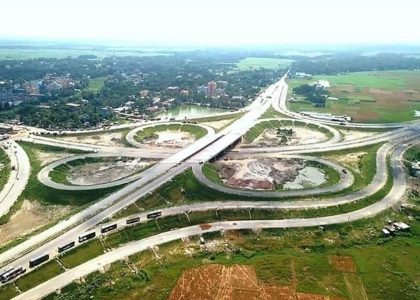
Matribhumi Resort and the adjoining Matribhumi Smart City sit along the Dhaka-Mawa Expressway near Nimtola, in the same corridor that has seen accelerating hospitality and residential development since the Padma Bridge cut travel time from the capital to a fraction of what it used to be. For an NRB planning an eventual return to Bangladesh, or simply a reliable place to stay during annual visits, that connectivity to Motijheel and central Dhaka matters as much as the property itself.
You can review the full details of both the residential township and its amenities directly through the official Matribhumi site, including the RAJUK and National Housing Authority approvals behind the broader Matribhumi Group portfolio.
Frequently Asked Questions
Do NRBs have the same property rights as residents of Bangladesh? Yes, NRBs hold the same legal property ownership rights as resident Bangladeshi citizens for residential and commercial real estate, though agricultural land can generally only be inherited rather than purchased directly.
What is a Saf Kabala deed and why does it matter so much? It is Bangladesh’s final, registered sale deed. Legal ownership of land only transfers once this deed is properly registered at the Sub-Registrar’s office, which makes it the single most important document in any land purchase.
Is a resort share investment the same as owning a plot of land? No. A resort share typically represents a stake in the resort as a business, documented through a separate agreement rather than a land title, so it is worth reviewing the exact legal structure with a lawyer before investing.
Can I register property in Bangladesh without traveling there in person? Yes, through a registered Power of Attorney executed at a Bangladeshi embassy, which allows the registration process to proceed on your behalf.
Are passive income projections from resort share investments guaranteed? No. Returns depend on the resort’s actual occupancy and operational performance, and any specific figure quoted in marketing material should be treated as a projection rather than a promise.
Final Thoughts
Investing money you earned abroad into land or property back home is rarely just a financial decision. For most NRBs, it carries a weight that a stock portfolio or a savings account never quite manages, a sense of building something permanent in the place they still think of as home.
That weight is exactly why the legal details matter so much. A properly registered Saf Kabala deed, a clearly documented resort share agreement, funds moved through the correct banking channels, these are not bureaucratic inconveniences. They are what turns a hopeful investment into a genuinely secure one.
If you are an NRB considering either a plot in Matribhumi Smart City or a resort share in Matribhumi Resort, take the time to request the exact legal documentation for whichever structure interests you, and have it reviewed independently before committing your funds. You can reach out through the official Matribhumi site to request the current documentation and discuss your specific situation with their team.
This article is written for general information and does not constitute legal or financial advice. Property law, tax treatment, and investment terms can change, and your personal situation may involve details this overview cannot cover, so it is always worth consulting a qualified property lawyer and financial advisor in Bangladesh before finalizing any investment.
The money you have sent home over the years has already done a great deal of good. What you choose to build with what remains is worth deciding carefully, not quickly.